SemiFedER: Semi-supervised Federated Averaging for Multimodal Emotion Recognition
A federated learning pipeline for multimodal emotion recognition that supports partially labeled, speaker-partitioned client data.
Nhut Minh Nguyen · Thu Thuy Le · Trung Thanh Nguyen · Duc Ngoc Minh Dang
Abstract
Multimodal Emotion Recognition (MER) is a powerful approach for human–computer interaction, leveraging complementary cues across multiple modalities to infer human affect. MER has broad real-world potential in applications such as healthcare monitoring and affect-aware virtual assistants. However, practical deployments face two major challenges: large-scale data is often unlabeled due to the high cost of emotion annotation, and speech signals and transcripts are privacy-sensitive, limiting centralized data collection and training. To address these limitations, we propose SemiFedER, a semi-supervised federated learning framework for MER. SemiFedER performs client-side training in two stages, including supervised pre-training on labeled samples and semi-supervised learning that exploits unlabeled data via confidence-based pseudo-labeling and weak-strong consistency regularization. The server aggregates client updates using Federated Averaging (FedAvg) to learn a global model without sharing raw data. We deploy the representative centralized MER backbones within SemiFedER to assess their effectiveness in this practical setting. Extensive experiments on the MELD dataset under speaker-disjoint non-IID federated splits demonstrate that SemiFedER provides stable performance across labeled ratios and client counts, and achieves competitive improvements in class-balanced evaluation compared to centralized baselines.
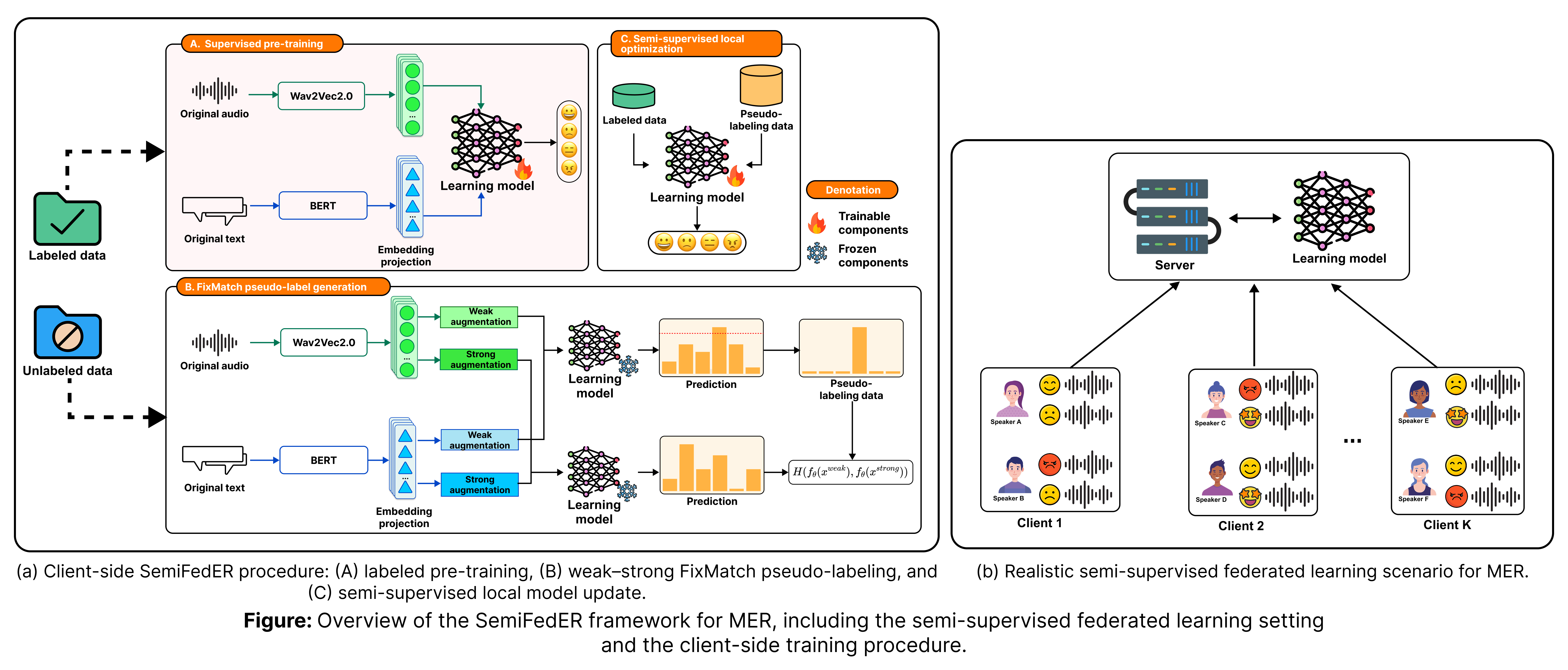
Figure 1. Overview of the SemiFedER pipeline for semi-supervised federated multimodal emotion recognition.
Privacy-aware
Training is distributed across clients so that raw samples do not need to be centralized.
Semi-supervised
Configurable labeled ratios support experiments where only a subset of client samples has emotion annotations.
Multimodal
Audio and textual information are extracted and fused for seven-class emotion recognition on MELD.
Get Started Locally
Setup
Python 3.8 or newer is recommended.
git clone https://github.com/nhut-ngnn/SemiFedER.git
cd SemiFedER
python3 -m venv .venv
source .venv/bin/activate
pip install -r requirements.txt
On Windows PowerShell, activate the environment with .venv\Scripts\Activate.ps1.
Recommended Federated Run
Set audio_root in federated/configs/meld.yaml to the MELD audio directory, then run:
python3 federated/pipeline_runner.py \
  --config federated/configs/meld.yaml
If pipeline.run_id is configured, it is appended to the generated metadata and feature paths.
Project Layout
-
centralized/— preprocessing, feature extraction, and centralized training. -
federated/— client preprocessing, pipeline configuration, and federated training. -
src/— model implementations and shared utilities. -
metadata/andfeatures/— generated splits and extracted feature files. -
checkpoints/,logs/, andresults/— experiment outputs.
Dataset Preparation
Download MELD and keep its audio files in a stable local directory. The examples below use /path/to/MELD for the dataset and /path/to/MELD_audio for extracted audio.
Cite This Work
If SemiFedER helps your research, please cite the MLHMI 2026 publication.
@inproceedings{Nguyen2026SemiFedER,
  title = {SemiFedER: Semi-supervised Federated Averaging for Multimodal Emotion Recognition},
  author = {Nguyen, Nhut Minh and Le, Thu Thuy and Nguyen, Thanh Trung and Dang, Duc Ngoc Minh},
  booktitle = {Proceedings of the 7th International Conference on Machine Learning and Human-Computer Interaction (MLHMI 2026)},
  year = {2026},
  address = {Tokyo, Japan},
  doi = {10.23919/MLHMICPS00004.2026.00038},
}
Collaborators
- Nhut Minh Nguyen, FPT University, Vietnam
- Thu Thuy Le, FPT University, Vietnam
- Thanh Trung Nguyen, FPT University, Vietnam
- Duc Ngoc Minh Dang, FPT University, Ho Chi Minh, Vietnam
Reach out via minhnhut.ngnn@gmail.com for collaborations, demo requests, or dataset access.
MLHMI 2026 · Tokyo, Japan
Presented at 2027 8th International Conference on Machine Learning and Human-Computer Interaction.
SemiFedER is part of an ongoing effort to advance emotionally aware multimodal AI systems.